Services & Customer Engagement Case study
BrightBridgeConnect
A web-based service and customer-engagement platform.
Services & Customer Engagement
BrightBridgeConnect BrightBridgeConnect
Web Platform Engineering
System map · Workflow
Engineering scope
- Failures made visible The one failure otherwise invisible to everyone involved
- The path is the product Onboarding and enquiry treated as the commercial surface
Conversion path
Arrive
Service-specific journeys
Interest
The service, not the company
Get started
Validation that guides, not blocks
Capture
International contact details
Enquiry
Delivered, or visibly not
Delivery failure surfaced, not silent
Engineering
Web platform · Customer onboarding · Conversion workflows · Production delivery
Public product · Proprietary source code
- Role
- Web Platform Engineering
- Disclosure
- Public product · Proprietary source code
- Links
- Product website
The problem
What the system had to solve.
For a services business, the web platform is not a shop window in front of the product — to a prospective customer it is the product, until a person calls them back.
Everything is judged on one question: how many of the people who arrive complete the step that puts them in touch.
What I owned
The responsibility behind the work.
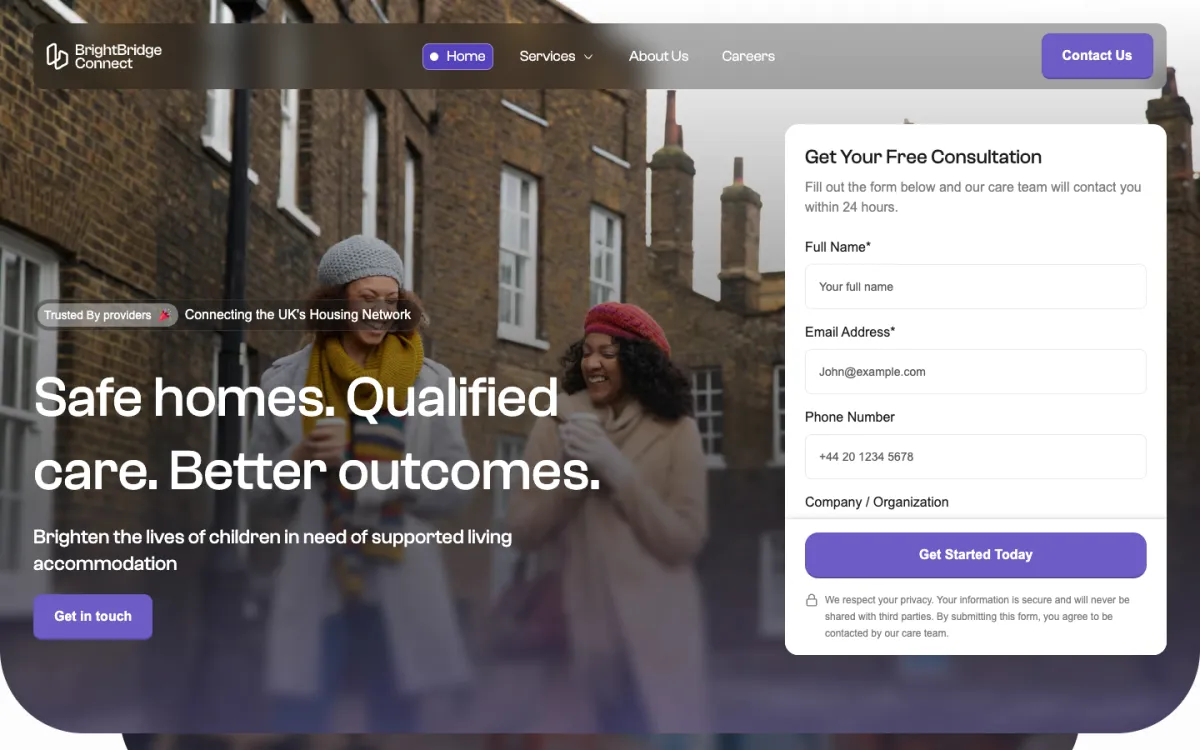
Developed and maintained the web platform across customer onboarding, Get Started workflows, sales-funnel functionality, service-related user journeys and production improvements.
Engineering approach
How it was built.
The conversion path is the product, so the engineering concentrates there: validation that guides rather than blocks, contact details handled correctly for international users, and enquiry delivery treated as a path where failure must be visible rather than silent. Journeys are service-specific, because every additional field costs completions and a generic form costs them for no benefit.
Conversion path
- Arrive
- Interest
- Get Started
- Capture
- Enquiry
The product is the conversion path
When onboarding is the whole application.
For a services business, the web platform is not a shop window in front of the product — for a prospective customer it is the product, right up until a person calls them back. Everything is judged on one question: how many of the people who arrive complete the step that puts them in touch.
That makes the engineering work unusually measurable, and unusually unforgiving. A form field that confuses people, a validation message that fires too early, a page that loads slowly on a phone — each is a percentage of enquiries that never arrive.
The path being optimised
- Arrival
- Service interest
- Get Started
- Details captured
- Enquiry delivered
Capturing an enquiry reliably
The part that must not fail quietly.
A submitted enquiry that never reaches the business is worse than a broken form, because nobody finds out. Enquiry capture and delivery is the one path where failure has to be visible: validated on the way in, delivered reliably, and surfaced when delivery does not succeed.
What the capture path requires
- Validation that guides rather than blocks
- International contact details handled correctly
- Reliable transactional delivery
- Failures that are visible rather than silent
Service-specific journeys
Different services, different questions.
Different services need different information before a business can respond usefully, so the journey is not one generic form. Asking only what a given service actually needs is the difference between an enquiry a business can act on and one that requires a phone call to make sense of.
Each additional field costs completions. The design question is which ones earn their place for this service, not how much can be collected.
Engineering scope
What I worked on.
- Customer onboarding
- Get Started conversion workflows
- Sales-funnel functionality
- Service-related user journeys
- Production improvements
Why these decisions mattered
The trade-offs behind the platform.
Treat the funnel as the product
Make delivery failures visible
Service-specific journeys
Impact
What the work targets.
The enquiry path is built so a submission is validated, delivered reliably, and surfaced when delivery fails — the one failure that is otherwise invisible to everyone involved.
Technology
The technical surface.
- Web platform
- Customer onboarding
- Sales funnels
- Production delivery