FinTech · AI Case study
Asteria Smart Cash Flow
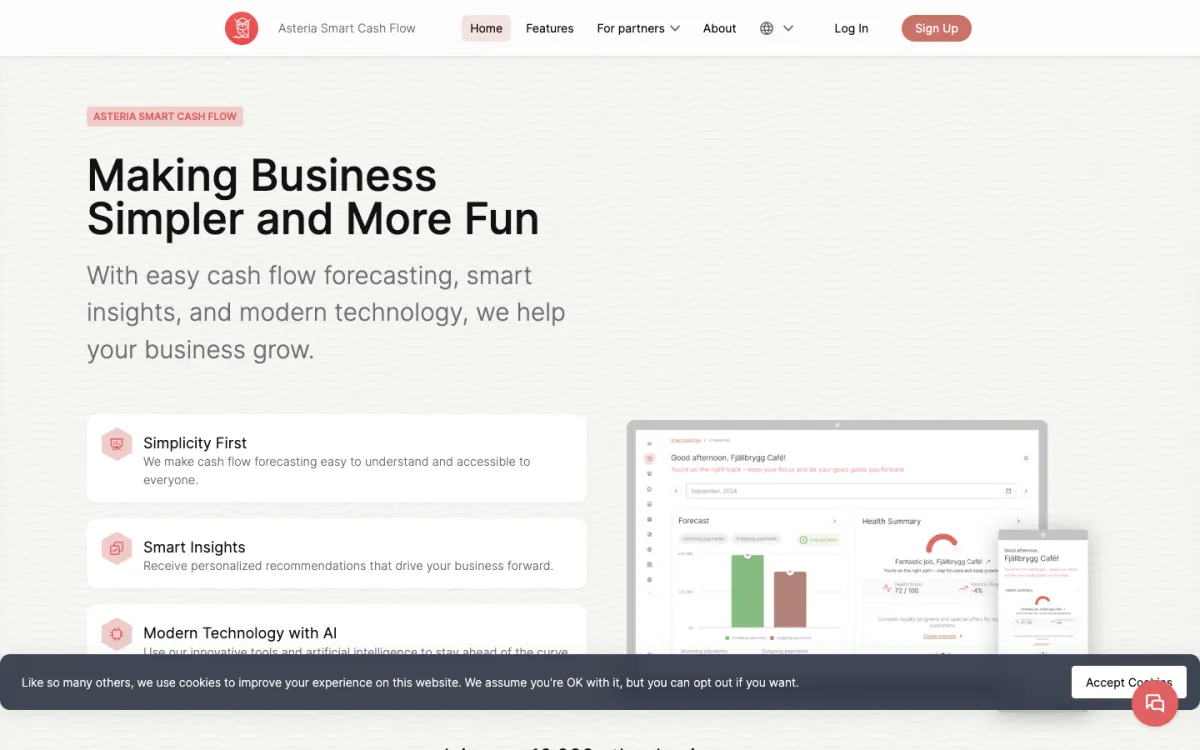
An AI-powered financial-management platform for cash-flow forecasting, transaction analysis, invoice monitoring and financial-risk identification.
FinTech · AI
Asteria Smart Cash Flow Asteria Smart Cash Flow
Main Engineer · Portfolio & Product Engineering
System map · Processing pipeline
Engineering scope
- Banking integration end to end Institution standards and strong authentication
- Known vs projected The presentation never confuses the two
Data path
Bank
Institution-specific standards
Transactions
Secure handling end to end
Analysis
Transaction and invoice analysis
Forecast
A projection, not a record
Present
Known kept distinct from projected
Also delivered
- Headless content platform
- Public product portfolio
Engineering
Contentful · Headless CMS · Banking integrations · Secure data flows
Public product · Financial implementation details omitted
- Role
- Main Engineer · Portfolio & Product Engineering
- Disclosure
- Public product · Financial implementation details omitted
- Links
- Product website
The problem
What the system had to solve.
A business does not fail because it is unprofitable. It fails because money is not in the account on the day something has to be paid. Accounting says what happened; cash-flow forecasting has to say what is about to.
That requires reliable access to banking data before any of the analysis is possible, under security expectations that are not negotiable.
What I owned
The responsibility behind the work.
Developed the public portfolio on a headless content platform and contributed to AI-assisted financial functionality and Swedish banking integrations, including secure financial-data processing and presentation.
Engineering approach
How it was built.
Banking integration is the foundation: no forecast is better than the transaction data underneath it, and each institution brings its own standards and authentication model. Secure handling applies to every path touching financial data, including read-only display paths, and presentation distinguishes recorded figures from projections so a business does not act on an estimate as though it were a balance.
Data path
- Bank
- Transactions
- Analysis
- Forecast
- Present
Cash flow is a prediction problem
What a small business actually needs to know.
A business does not fail because it is unprofitable. It fails because money is not in the account on the day something has to be paid. Accounting tells you what happened; cash-flow forecasting has to tell you what is about to.
That means reading transactions, invoices and their payment behaviour, and projecting forward with enough confidence to be acted on — which is a data and modelling problem sitting on top of a banking integration problem.
What the platform addresses
- Cash-flow forecasting
- Transaction analysis
- Invoice monitoring
- Financial-risk identification
Connecting to banks
The unglamorous foundation everything rests on.
None of the analysis is possible without reliable access to transaction data, and banking integration is where financial products are hardest and least forgiving. Swedish banking systems have their own standards, authentication models and data shapes, and the security expectations around them are not negotiable.
What integration demands
- Institution-specific standards
- Strong authentication requirements
- Secure handling of financial data end to end
- Careful treatment of data at rest and in transit
In a financial product, secure data handling is not a feature that sits alongside the others. It is a property every path has to hold, including the ones that only display information.
Presenting a forecast honestly
A projection is not a fact.
Financial data presentation carries a specific obligation: a forecast is an estimate, and showing it with the same visual confidence as a bank balance invites a business to act on it as though it were one. The presentation layer has to distinguish what is known from what is projected.
The public portfolio
A content-managed site for a financial product.
Alongside the product, the public site was built on a headless content platform so marketing and content teams could publish without engineering involvement. For a financial product this matters more than usual: public claims about a financial service change often and are subject to review, and routing every change through a deployment makes that slower and more error-prone than it needs to be.
Why headless content management
Content in code
- Every copy change is a deployment
- Engineering is a bottleneck
- Corrections are slow
Headless CMS
- Content teams publish directly
- Structured, reusable content
- Presentation stays with engineering
Engineering scope
What I worked on.
- Contentful-powered public portfolio
- AI-assisted financial functionality
- Swedish banking-system integrations
- Secure financial-data processing
- Data presentation workflows
Why these decisions mattered
The trade-offs behind the work.
Integration before intelligence
Security as a property, not a feature
Distinguish known from projected
Headless content management
Impact
What the work supports.
Forecasting, transaction analysis and invoice monitoring rest on reliable banking data, presented so that what is known stays visually distinct from what is projected.
Technology
The technical surface.
- Contentful
- Headless CMS
- Banking integrations
- AI-assisted finance
- Secure data flows