Customer Experience Case study
Servicelovers
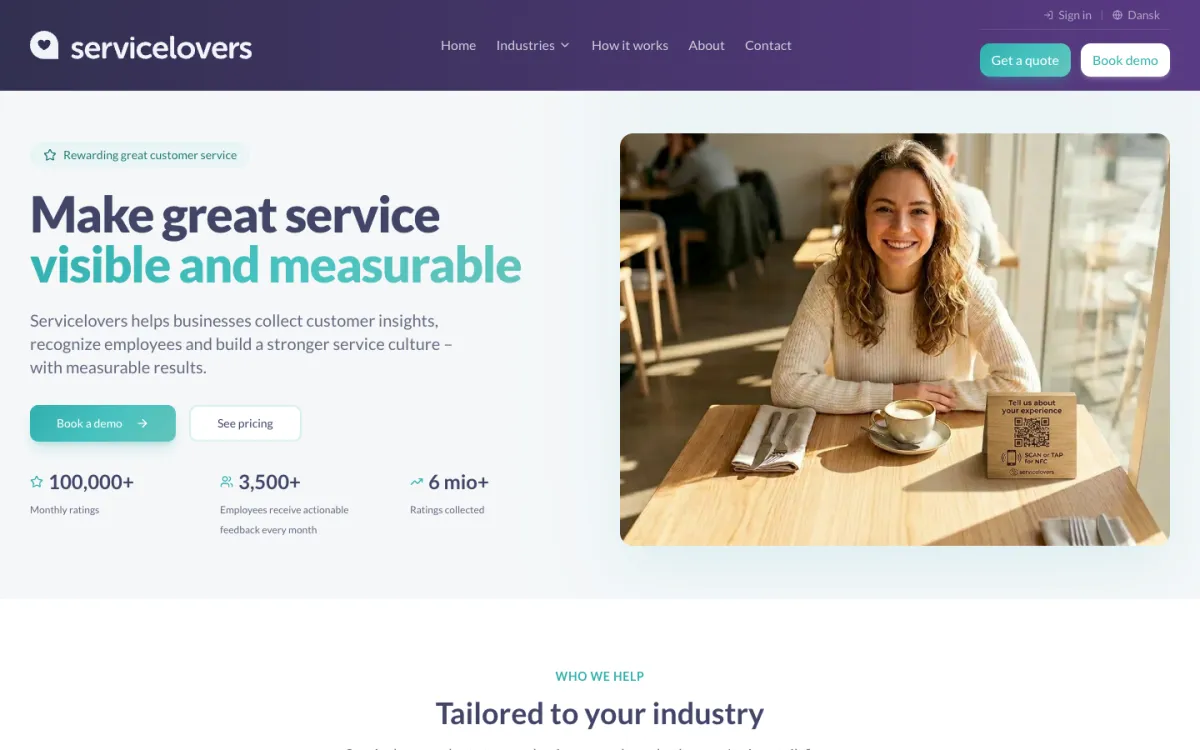
A customer-experience and employee-recognition platform for real-time feedback, service measurement and frontline recognition.
Customer Experience
Servicelovers Servicelovers
Lead Software Engineer
System map · Operational ecosystem
Engineering scope
- Five surfaces, one model Five definitions of a service interaction produce no answers
- Attributed to a person Which turns a location metric into recognition
Feedback path
Service
The moment itself
Capture
In-store, web and mobile surfaces
Attribute
To the person who delivered it
Two products, one dataset
Measurement
What management sees
Recognition
What the frontline sees
Surfaces delivered
- In-store feedback application
- Customer-rating web
- Social mobile application
- Administrative platform
Engineering
Web applications · Mobile applications · Administrative systems · Feedback workflows
Public product · Proprietary source code
- Role
- Lead Software Engineer
- Disclosure
- Public product · Proprietary source code
- Links
- Product website
The problem
What the system had to solve.
Asking someone what they thought of a service two days later gets a different answer than asking as they leave, and far fewer answers. Real-time service measurement has to be collected where the service happened.
That makes it an ecosystem rather than an application: the customer, the frontline employee and the manager each need a different surface, in a different place, at a different moment.
What I owned
The responsibility behind the work.
Contributed across the full product ecosystem: the public portfolio, the administrative platform, the customer-rating web experience, the social mobile application and the in-store feedback application.
Engineering approach
How it was built.
Five surfaces share one model of a service interaction, because five applications that each define it slightly differently produce five sets of numbers and no answers. Attributing feedback to the employee who delivered the service turns a location metric into recognition, which is why the social surface exists separately from the reporting one.
Feedback path
- Service
- Capture
- Attribute
- Measure
- Recognise
Feedback has to be collected in the moment
Why this is not a survey product.
Asking someone what they thought of a service two days later gets a different answer from asking them as they leave, and far fewer answers. Real-time service measurement therefore has to be collected where the service happened — at the counter, in the store, on the way out — not emailed afterwards.
That constraint is what makes it an ecosystem rather than an application. The customer, the frontline employee and the manager each need a different surface, in a different place, at a different moment.
One platform, several surfaces
- Service measurement platform
- In-store application Feedback at the point of service
- Customer-rating web Rating away from the counter
- Social mobile application Recognition between employees
- Administrative platform Measurement and management
Measurement that names people
The difference between a score and recognition.
Most feedback products measure a location and stop. Attributing feedback to the person who delivered the service turns a metric into recognition, which is a different product with a different obligation: if praise is going to be attached to individuals, the attribution has to be right and the surrounding experience has to be built for people rather than for reporting.
Two products from the same data
Measurement
- Service scores by location
- Trends over time
- Management reporting
Recognition
- Feedback attributed to individuals
- Visible appreciation
- A social surface for frontline staff
Working across the whole ecosystem
What lead engineering meant here.
The work spanned the public marketing site, the administrative platform, the customer-rating web experience, the social mobile application and the in-store feedback application. Five surfaces sharing one model of a service interaction, where an inconsistency between any two of them shows up as a number that does not reconcile.
Surfaces delivered
- Public marketing portfolio
- Administrative platform
- Customer-rating web experience
- Social mobile application
- In-store feedback collection application
The coordination problem is the engineering problem. Five applications that each define "a service interaction" slightly differently produce five sets of numbers and no answers.
Engineering scope
What I worked on.
- Public marketing portfolio
- Administrative platform
- Customer-rating web experience
- Social mobile application
- In-store feedback collection application
Why these decisions mattered
The trade-offs behind the ecosystem.
Collect at the point of service
Attribute feedback to people
A separate social surface
One shared model across five surfaces
Impact
What the ecosystem delivers.
Feedback is captured at the point of service rather than after it, and attributed to the person who delivered it, so the same data serves both management measurement and frontline recognition.
Technology
The technical surface.
- Web applications
- Mobile applications
- Administrative systems
- Customer feedback workflows